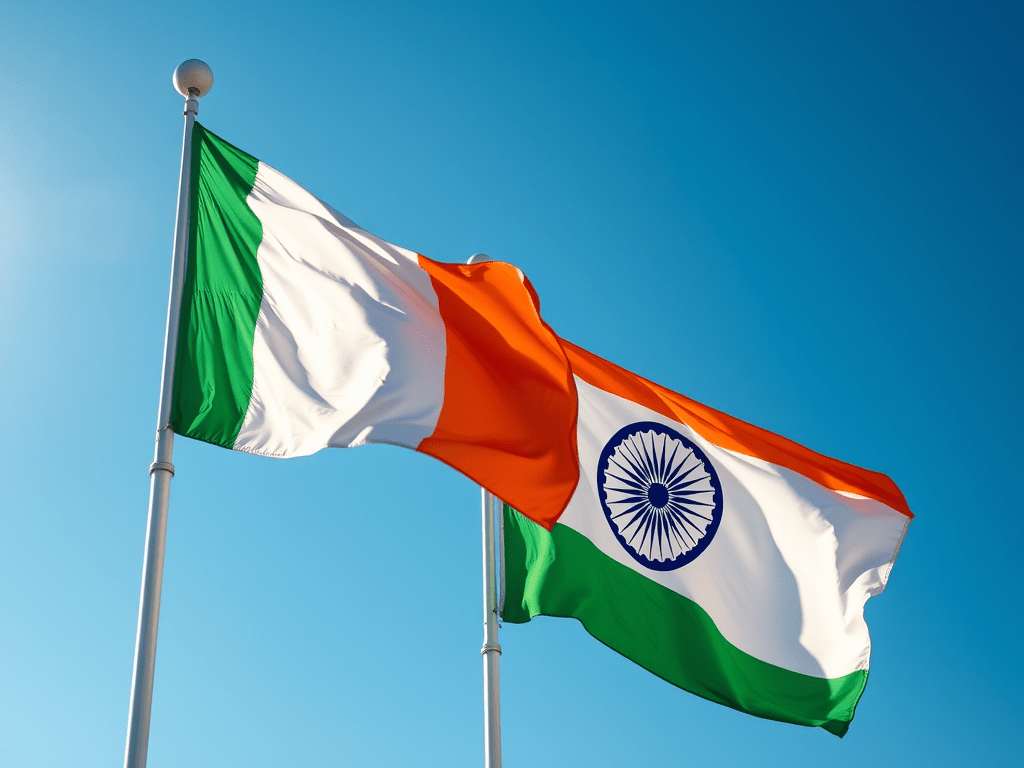
*Sanskrit is a classical language belonging to the Indo-Aryan branch of the Indo-European languages. It arose in South Asia after its predecessor languages had diffused there from the northwest in the late Bronze Age. Era: circa 1500 – 600 BCE Vedic Sanskrit. 700 BCE – 1350 CE Classical Sanskrit.
*Irish, or ‘Irish Gaelic’/’Gaelic’, is a Goidelic language of the insular Celtic branch of the Celtic language group, which is part of the Indo-European language family.

The following text is taken from pages 6-7 in the book: The Celts. By Peter Berresford Ellis. Published by Robinson, London, 2003.
What is extraordinary are the close similarities that have survived between Irish and Vedic Sanskrit, two cultures which developed thousands of miles apart over thousands of years. When scholars began to seriously examine the Indo-European connections in the nineteenth century they were amazed at how old Irish and Sanskrit had apparently maintained close links with their Indo-European parent. This applies not only in the field of linguistics but in law and social custom, in mythology, in folk custom and in traditional musical form.
The following examples demonstrate the similarity of the language of the Vedic laws of Manu and that of the Irish legal texts, the laws of the Fenechus, more popularly known as the Brechon laws.
Sanskrit.
Aire (freeman).
Naib (good).
Badhira (deaf).
Minda (physical defect).
Names (respect).
Raja (king).
Vid (knowledge).
Old Irish.
Aire (noble).
Noeib (holy).
Bodhar (deaf).
Menda (a stammerer).
Nemed (respect/privilege).
Ri (king).
Uid (knowledge).
Arya gives us the much misunderstood term Aryan; the old Irish noeib becomes the modern Irish naomh, a saint; and the Irish bodhar (deaf) was borrowed into eighteenth century English as ‘bother’. To be ‘bothered’, is literally to be deafened. Finally, the word vid, used not only for knowledge but for understanding, is the root of veda; the vedas constitute the four most sacred books of Hinduism – the Rig Veda, Yajur Veda, Sama Veda, Atharva Veda. The same root can be seen in the name of the Celtic intellectual caste, the Druids – i.e. druvid which some have argued meant ‘thorough knowledge’.
Unfortunately, no complete ‘creation’ myth of the Celts has survived. When these myths came to be written down, in the insular Celtic languages of Irish and Welsh, Christianity had taken a hold and the scribes bowdlerised the stories of the gods and goddesses thus obscuring their symbolism and significance. That the Celts did have a vibrant and rich pre-Christian mythology, including a creation myth, is seen not only in the Christianised stories but in the few allusions in the classical writers. However, most of the classical writers tend, like the Christians after them, to incorporate the Celtic myths and gods into their own cultural ethos.

The fact is that many of the surviving Irish myths, and some of the Welsh ones, show remarkable resemblances to the themes, stories and even names in the sagas of the Indian Vedas. Once again, this demonstrates the amazing conservation of cultural tradition. By comparing those themes we find that Danu, sometimes Anu in Old Irish and Don in Welsh, and also surviving in the epigraphy of the continental Celts, was the mother goddess. She was the ‘divine waters’ which gushed back to earth in the time of primal chaos and nurtured Bile the sacred oak, from whom the gods and goddesses sprang. Her waters formed the course of the Danuvius (Danube).
The story associated with the Danuvius, which is arguably the first great Celtic sacred river, has similarities with myths about the Boyne, from the goddess Boann, and the Shannon, from the goddess Sionan, in Ireland. More importantly, it bears a close resemblance to the story of the Hindu goddess Ganga, deity of the Ganges. Both Celts and Hindus worshipped in the sacred rivers and made votive offerings there. In the Vedic myth of Danu, for she exists as a deity in Hindu mythology as well, the goddess appears in he famous Deluge story called ‘The Churning of the Ocean’.
End of extract from ‘The Celts’ by Peter Berresford Ellis.
The Celtic Druids bore similarities with the Brahmins of the Hindu religion and were something of a parallel development from their common Indo-European cultural root which began to extend roughly five thousand years ago. Only in recent decades have Celtic scholars begun to reveal the full extent of the parallels and cognates between ancient Celtic society and Vedic culture.
The following is sourced from the ‘Sanskriti Magazine’.
The Celts were the first civilization north of the European Alps to emerge into recorded history. At the time of their greatest expansion, in the 3rd century bce, the Celts stretched from Ireland in the west, through to the central plain of Turkey in the east; north from Belgium, down to Cadiz in southern Spain and across the Alps into the Po Valley of Italy. They even impinged on areas of Poland and the Ukraine and, if the amazing recent discoveries of mummies in China’s province of Xinjiang are linked with the Tocharian texts, they even moved as far east as the area north of Tibet.

The once great Celtic civilization is today represented only by the modern Irish, Manx and Scots, and the Welsh, Cornish and Bretons. Today on the northwest fringes of Europe cling the survivors of centuries of attempted conquest and “ethnic cleansing” by Rome and its imperial descendants. But of the sixteen million people who make up those populations, only 2.5 million now speak a Celtic language as their mother tongue.
The Druids were not simply a priesthood. They were the intellectual caste of ancient Celtic society, incorporating all the professions: judges, lawyers, medical doctors, ambassadors, historians and so forth, just as does the brahmin caste. In fact, other names designate the specific role of the “priests.” Only Roman and later Christian propaganda turned them into “shamans,” “wizards” and “magicians.” The scholars of the Greek Alexandrian school clearly described them as a parallel caste to the brahmins of Vedic society.

The very name Druid is composed of two Celtic word roots which have parallels in Sanskrit. Indeed, the root vid for knowledge, which also emerges in the Sanskrit word Veda, demonstrates the similarity. The Celtic root dru which means “immersion” also appears in Sanskrit. So a Druid was one “immersed in knowledge.”
Because Ireland was one of the few areas of the Celtic world that was not conquered by Rome and therefore not influenced by Latin culture until the time of its Christianization in the 5th century CE, its ancient Irish culture has retained the most clear and startling parallels to Hindu society.
Comparing poems…
The Song Of Amairgen The Druid.
I am the wind that blows across the sea; I am the wave of the ocean;
I am the murmur of the billows; I am the bull of the seven combats;
I am the vulture on the rock; I am a ray of the sun; I am the fairest of flowers;
I am a wild boar in valour; I am a salmon in the pool; I am a lake on the plain;
I am the skill of the craftsman; I am a word of science;
I am the spearpoint that gives battle;
I am the God who creates in the head of man the fire of thought.
Who is it that enlightens the assembly upon the mountain, if not I?
Who tells the ages of the moon, if not I?
Who shows the place where the sun goes to rest, if not I?
Who is the God that fashions enchantments–
The enchantment of battle and the wind of change?

Declaration Of Krishna.
I am the taste in the waters, O Son of Kunti.
I am the syllable Aum in all the Vedas.
I am the sound in ether and manhood in men.
I am the pure fragrance on earth and brightness in fire.
I am the life in all existences and the austerity in ascetics.
Know Me, O Partha, to be the eternal seed of all existences.
I am the intelligence of the intelligent.
I am the splendour of the splendid.
I am the strength of the strong, devoid of desire and passion.
In beings I am the desire which is not contrary to dharma, O Lord of the Bharatas.
And whatever states of being there may be, be they harmonious, passionate, slothful–
know they are all from Me alone.
I am not in them, they are in Me.

Five interesting similarities/parallels between the two cultures:
1) Celtic cosmology recognizes four interrelating worlds of existence: netherworld, earth realm; heavenly realm of dead and demi-gods; white realm of supreme Deities and energy source of stars.
Vedic cosmology perceives three interrelating worlds-physical; astral world of dead and demi-gods; causal universe of Deities, Supreme Being and primal energy; plus a fourth netherworld.
2) Celtic earth realm is called bitus. Celtic Gods are called deuos, meaning “shining one”.
Vedic earth world is called bhu. Gods of Vedas are invoked as deva, meaning “shining one”.
3) Celtic deities included Gods who actualized nature forces, promulgated ethics, justice, knowledge, speech, arts, crafts, medicine, harvests, gave war courage and battled forces of darkness, and Goddesses of land, rivers and motherhood. Gods often did multiple functions.
The early Vedic pantheon included deities of fire, solar, atmospheric and nature forces, ritual stimulants, speech, crafts, arts, harvests, medicine, justice, ethical/ecological order, war, battlers of malevolent beings, river Goddesses. Gods often had overlapping functions.
4) Celtic society was divided into three hierarchical stratas of life: priests, warriors and producers (inclusive of merchants). Druids advised warrior-kings known as rix. Upward progression through classes was possible.
Vedic society was divided into four hierarchical castes: priests, warriors, merchants, workers. Brahmins counsel warrior-kings (rajas). Upward mobility was sanctioned in Vedas, but later frozen in societal law books.
5) Celts honoured women, guarded their virtue, and allowed by law daughters of sonless fathers to inherit property or to marry kinsmen to bear male heirs to the father. Seeresses were sanctioned, and priestesses for Goddesses favoured.
Vedic Hindus prized womanly virtues, and by law sonless fathers could bequeath property to daughters or arrange her marriage to relatives for male heirs. Female seers were countenanced, and female ascetics tended Goddess rites.
- As an interesting ‘fun fact’, the first works of literature produced in Europe were (alongside those of both Ancient Greece and Rome) written in Irish dating as far back as the 6th Century AD.
The History Scrutineer wishes to mention that there are further theories and studies which are held and have been engaged in by certain historians/anthropologists stating that the Ancient Celts and Irish (in particular) are the descendants of other ancient peoples with claims as wide-ranging as the Sythians, the Egyptians and even the Atlanteans!
We shall aim to deliver more articles on these subject matters, which are, quite surely – most thought-provoking!
It would indeed appear however, based on language and ancient societal customs, that there are strong-enough looking links connecting Irish to Sanskrit and vice-versa…



 The History Scrutineer
Leave a comment