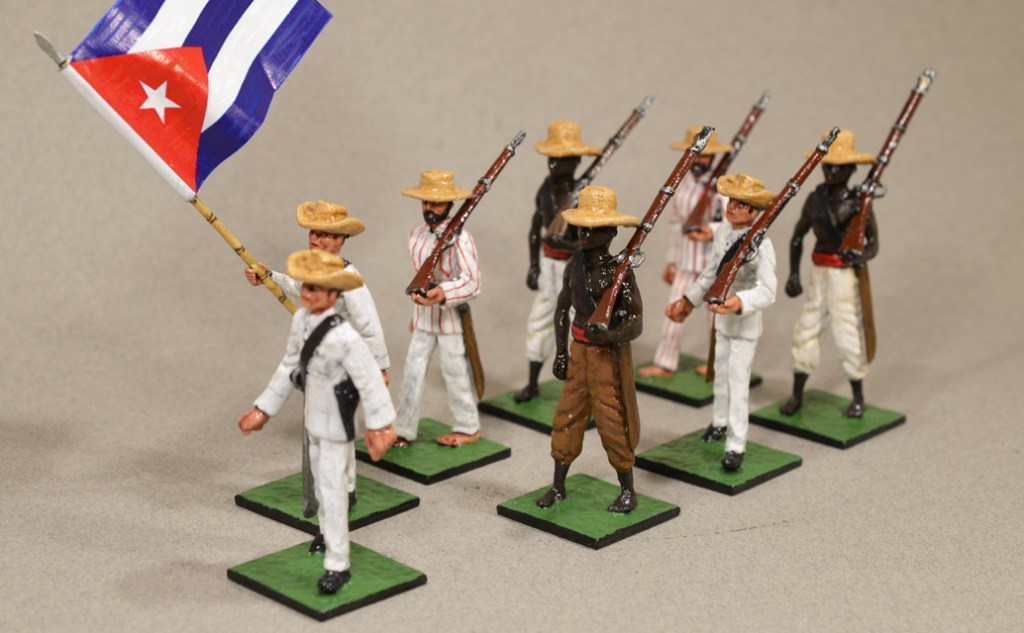
The term mambises refers to the Cuban guerrillas who fought against the Spanish during the Ten Years’ War (1868–1878) and the War of Independence (1895–1898). The mambises are named after black Spanish officer Juan Ethninius Mamby, who joined the fight for Dominican independence in 1846 in Santo Domingo. The Spanish began to refer to the guerrillas as “the man of Mamby,” or “mambies” as a derogatory term. When the Ten Years’ War began many of the soldiers that fought in Santo Domingo were reassigned to Cuba where they applied the related term “mambises” to Cuban fighters; the Cuban fighters adopted the name with pride.
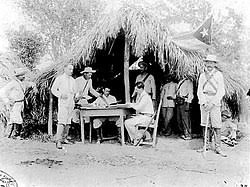
The mambises comprised of a mixture of indigenous, Afro Cuban, Asian Cuban, and Spanish descendants. They called on agricultural workers and freed slaves to join them. They were mainly poor men, who wore typical white and straw hats. They were poorly armed and outnumbered by the Spanish. Because the mambises had no access to conventional weaponry they had to use guerrillastyle tactics and were known for their use of the machete.
During the War of Independence they were led by General Máximo Gómez and General Antonio Maceo Grajales. Generals Maceo and Gómez led the forces west, to the greatest concentration of wealth and government. They traveled over a thousand miles in ninety-two days, fighting twenty-seven battles against numerically superior Spanish forces. Maceo was known as the “Bronze Titan” for being an outstanding leader. Despite Maceo’s death in December 1896, the mambises continued the fight until U.S. intervention in 1898.
Another important figure was General Valeriano Weyler y Nicolau, who led the Spanish forces against the mambises. He became known for the “re-concentration” camps used to separate common people from fighters. Anyone caught outside the camp would be considered the enemy and be killed.
Key, celebrated, and prominent mambí leaders included:
- Máximo Gómez (1836–1905): A Dominican-born general-in-chief of the Cuban Liberation Army. He was a brilliant strategist who implemented guerrilla tactics and utilized the “machete charge” to devastating effect against Spanish forces.
- Antonio Maceo (1845–1896): Known as “The Bronze Titan” (El Titán de Bronce), he was a mulatto field commander famed for his tactical skill, courage, and leadership in both the Ten Years’ War and the 1895 war.
- José Martí (1853–1895): A poet, intellectual, and key organizer of the 1895 War of Independence. He was the founder of the Cuban Revolutionary Party and is considered a national hero, though he died early in the 1895 conflict.
- Calixto García (1839–1898): A major-general in the Liberation Army who commanded forces in the Oriente province and later worked with American forces during the Spanish-American War.
- Henry Reeve (1850–1876): An American-born volunteer known as “El Inglesito” who fought alongside Maximo Gomez during the Ten Years’ War.
Characteristics of the Struggle
- Tactics: The Mambises were often poorly armed and fed, forcing them to use the machete and guerilla warfare—speed, surprise, and knowledge of the terrain—against well-trained Spanish soldiers.
- Composition: The forces were diverse, comprising white Cubans, free black people, slaves, and mulattos.
- Origin of Name: “Mambí” was originally a derogatory term used by the Spanish, derived from a Congolese officer, but it was accepted with pride by the Cuban rebels.
Note: The results also highlight the “Cuban Revolution” (1953–1959) which was a separate, 20th-century conflict against the Batista dictatorship, led by Fidel Castro and Che Guevara, which is often confused with the 19th-century independence struggle.
 The History Scrutineer
Leave a comment