
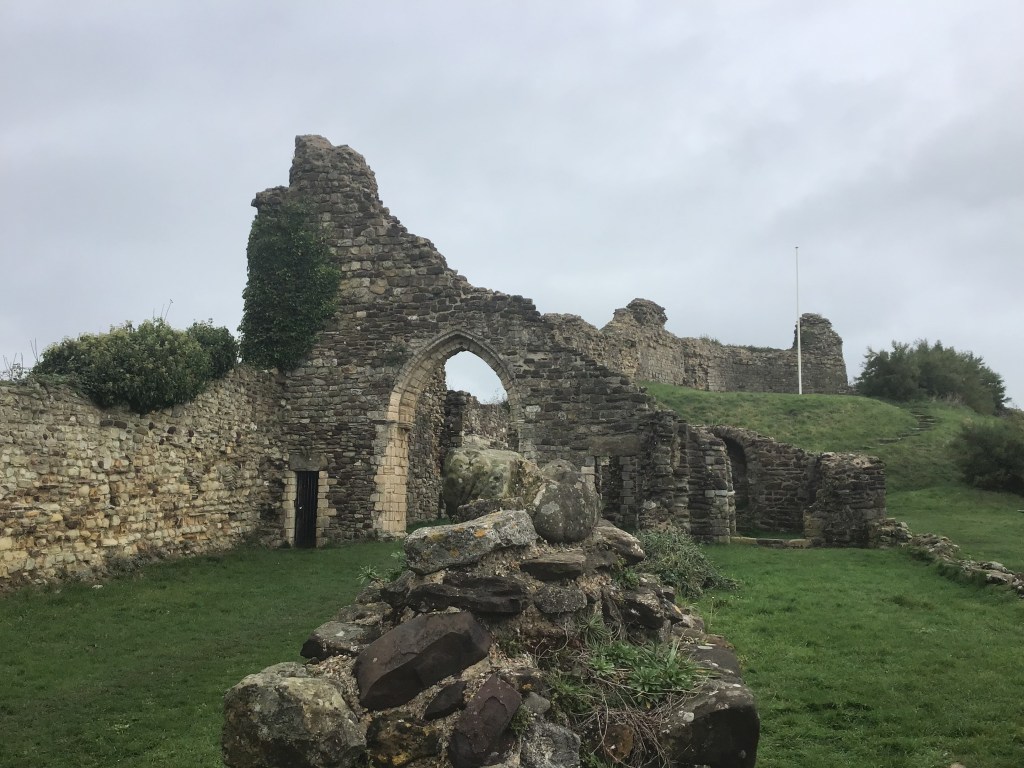
Hastings Castle, built atop the tallest hill overlooking the seaside town of Hastings, was recorded (and still recognised) as England’s first ‘motte-and-bailey’ castle, which was the architectural style of William The Conqueror and his Norman followers. The castle underwent much change over the centuries and endured many bitter phases as well as times of peace and pleasantry.
Following from www.visit1066country.com :
“Take a step back in time and discover the fascinating history of Britain’s first Norman castle – built by William The Conqueror in 1067. An iconic landmark of England’s tumultuous past, Hastings Castle represents a seismic shift in the direction of England; historically, politically and culturally. It is a jewel in the crown of England’s historic past. High above the town of Hastings, the castle boasts the most spectacular views in all of Sussex – and is the perfect spot for a family picnic.”


A basic timeline of the castle composed on Wikipedia:
Immediately after landing in England in 1066, William Of Normandy ordered three fortifications to be built, Pevensey Castle in September 1066 (re-using the Roman Saxon Shore fort of Anderitum), Hastings (prior to the Battle of Hastings) and Dover. Hastings Castle was originally built as a motte-and-bailey castle near the sea. Later that year, the famous Battle of Hastings took place some miles to the north of Hastings Castle, in which William was victorious. In 1070, William issued orders for the castle to be rebuilt in stone, along with the St Mary’s Chapel.

The Counts of Eu held the castle for most of the Norman period, beginning with Robert. In 1216, King John gave orders to destroy (slight) the castles at Hastings and Pevensey, while he retreated from a French army led by Dauphin Louis that had landed in Kent. In 1220, Henry III re-fortified the castle.

In time however the House of Eu forfeited control of Hastings Castle, when the family heir William made the decision to keep his French assets over the English ones, and was denied the right to his inheritance. In 1249, Henry III bestowed rule of the castle and its lands, to his wife’s uncle, Peter of Savoy. Peter held the rights from 1249 until 1254, whence they passed to the Lord Edward, future Edward I of England. In 1262 in need of funds Edward quitclaimed the honour and gave Hastings back to Peter who held the rights until his death in 1268.
In February 1287, violent storms hit the south coast of England with such force that the soft sandstone cliffs eventually succumbed to the elements. Large sections of the face fell into the sea along with parts of the castle.
In both 1339 and 1377, the town was attacked by the French leaving many burnt buildings which included homes. Throughout the next century erosion was unchecked and gradually more of the castle was lost to the sea.


The site was purchased by Thomas Pelham on 23rd June 1591. After the purchase, the site was owned by the Pelham family and used for farming until the ruins had become so overgrown they were lost from memory.
In 1824, the then owner, the Earl Of Chichester commissioned some archaeological investigations of the ruin. As a result of these, the chapel floor and parts of the arch and walls were re-constructed out of blocks found lying on the ground.
During World War II, the castle received more damage as Hastings was a target for bombing raids. In 1951, the Hastings Corporation purchased the site and converted it into a tourist attraction.


The castle is open to the public between March and October.
I, myself, Ben Anson, The History Scrutineer, very much enjoyed my little potter around the castle and the West Hill, which is (covered in one of the photo galleries of this article) a large expanse of grassy hilltop immediately behind the castle and a part of the most historic (nicest) area in all of Hastings. Just across the West Hill are the ‘Smuggler’s Caves’, where smugglers from roughly 1700-1840 operated very successfully in the region; bringing in all manner of products from lace to brandy (tea was the most popular by far) from France – notably – whilst avoiding the customs and heavy taxations of that period. The latter have only got worse however in England! If those smugglers could see it now… The Old Town is also just below the West Hill whereas further along the coast one would eventually reach the also historic villages/small towns of Fairlight and Rye.


The local authorities of Hastings would do well to make a more ‘impassioned’ effort in preserving these historic places and the few surviving remnants of local culture. The townsfolk have battled unemployment and lack of modern industry for a long time now, given that Hastings is no longer either a bustling English summer seaside town nor a thriving fishing community as it was decades and centuries ago. In truth, the entire area has ended up as (in large part) a dystopian never-ending expanse of housing estates and care-homes (sprawling over the hilly landscape that was at the time of the Saxon-Norman encounter all pristine, native British woodlands) with a dilapidated town centre.

The castle is a fascinating reminder of a very distant world and must be long-preserved. As shown in the photo galleries, man is disturbingly content to engrave utterly ugly and unnecessary nonsense in the dungeons and graffiti the information boards. Thus, historical conservation is a must and those working at Hastings Castle do seek to tackle criminal or immoral behaviour on the site.


In conclusion, I say long live all castles worldwide!





 The History Scrutineer
Leave a reply to Ben Anson Cancel reply