

Some stories of love withstand time, echoing across centuries as both a warning and a wonder. Few tales capture the imagination like the story of Pedro and Inês, two souls whose love defied convention, politics, and even death itself. Known as the “Juliet of Portugal,” the love story of Pedro and Inês is a tale of forbidden love, eternal love, and tragedy that shaped the history of Portugal.
The stage for this tragic romance was set in the 14th century, a pivotal period for Portugal. The first king of Portugal had secured independence only a few generations prior, and the royal family now faced delicate political pressures from neighboring Castile. Pedro’s father, King Afonso IV, was determined to protect his kingdom and maintain stability, not just for his reign but for the entire kingdom.
King Afonso IV arranged marriages and alliances with careful attention to diplomacy. His son, Prince Pedro of Portugal, was a dutiful heir, set to marry D. Constança Manuel, a Galician noblewoman and Princess of Castile. This union promised to secure peace with Castile, but as fate would have it, Pedro’s heart had other plans.
In 1340, the royal wedding took place. Pedro’s wife, D. Constança Manuel, was renowned for her beauty and grace, yet she would never hold Pedro’s heart. That honor fell to her handmaiden, Inês de Castro, a member of the influential Castro family. At first sight, Pedro was captivated. What began as a secret affair between a prince and a handmaiden would blossom into a passion so intense it would defy the royal court, the entire kingdom, and even death itself.
For years, Pedro and Inês carried on their secret affair, meeting in whispers and shadows. At first, it seemed harmless, a private love hidden behind the doors of palaces. But as time went on, Pedro’s neglect of his duties and the growing influence of Inês’ brothers, who were all tied to Castile, alarmed Pedro’s father. There were whispers at court that the future king of Portugal, Pedro’s son with Constança, could be endangered by Castilian plots, a true crime case centuries in the making.
In 1344, Alfonso’s patience ran out. He exiled Inês to the borderlands of Portugal, far from Coimbra and the royal court. But distance could not sever their bond. The lovers continued to meet in secret, their eternal love growing even stronger despite the king’s orders. Their clandestine meetings, once harmless, have now become a political threat. Nobles whispered, alarmed by Pedro’s close ties to Inês’ brothers and fearing Castilian influence over Portugal.

For Pedro, exile meant nothing. He refused to abandon his true love and continued to see Inês, a defiance that would have catastrophic consequences.
In 1355, tragedy struck again. D. Constança Manuel, Pedro’s wife, died giving birth to her first child, Ferdinand (future king D. Fernando). For a brief moment, it seemed Pedro might be free to follow his heart without political repercussions. Yet Pedro’s father had other plans. Alfonso IV refused to sanction Pedro’s union with Inês, fearing political upheaval.
The secret affair became more visible, and the entire court was in uproar. Rumors spread that Castile might attempt to assassinate Ferdinand, allowing Inês’ brothers and Castilian allies to place Pedro’s children with Inês on the throne. The tension escalated: love had collided with politics, creating a perilous situation for the royal family and the stability of the Portuguese throne.
Alfonso IV, fed up with Pedro’s defiance, ordered the murder of Inês de Castro. She was found at the Monastery of Santa Clara in Coimbra, where she was decapitated in front of her youngest child. Witnesses would later describe the chilling scene: a mother killed before her children, a true crime case that shocked the kingdom. The grief of Pedro was unparalleled.
At first, he was enraged, nearly sparking a civil war against his father. Pedro even launched a small rebellion, though his mother intervened to calm him. He promised not to pursue the assassins immediately, but he would not forget. When Pedro’s father died in 1357, Pedro became king, and his vengeance was swift and brutal.
Pedro tracked down the men responsible for Inês’ death: Álvaro Gonçalves, Diogo Lopes Pacheco, and Pêro Coelho. Legend says he tore their hearts out with his bare hands, earning him the fearsome nickname “Pedro the Cruel.” The royal family and nobles watched in stunned silence, aware that Pedro’s heart would not rest until justice, or vengeance, was served.
This act was not only personal; it was symbolic. Pedro’s actions cemented his reputation as a king who loved deeply but ruled with an iron will when it came to betrayal.
The most extraordinary chapter of the love story of Pedro came after vengeance was exacted. Pedro claimed that he and Inês had been secretly married, making her the queen of Portugal posthumously. In a legendary act, he exhumed Inês’ body, dressed her in royal robes, and placed her on the throne. The funeral procession required the entire court to pledge fealty by kissing her left hand, an eerie ceremony immortalizing their eternal love.
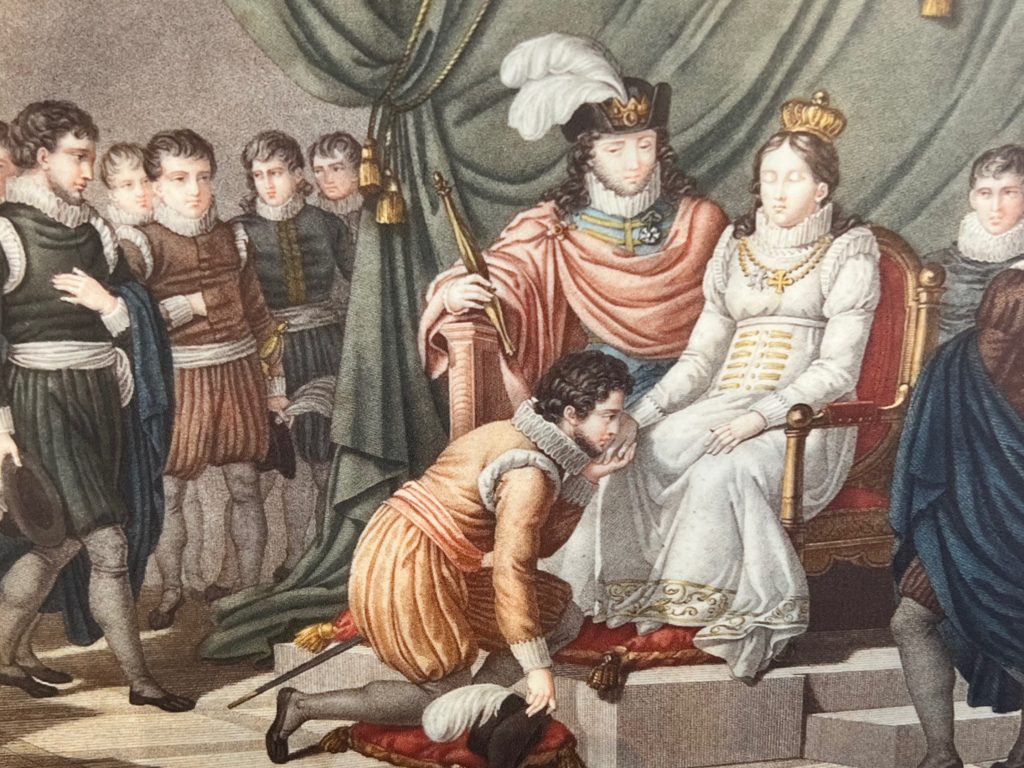
The love of Pedro and Inês is more than legend; it shaped the future king of Portugal, the succession of the Portuguese throne, and the memory of D. Inês de Castro as a dead queen whose dignity and passion transcended life. The tombs of D. Pedro and Inês remain a pilgrimage site, offering a glimpse of true love and the extreme devotion of a man who would not allow even death to separate him from his beloved.
From the city of Coimbra to the Castle of Albuquerque, the story permeates Portugal. Monuments, museums, fountains, and royal robes preserved in history serve as reminders of the love story nous, a narrative of devotion, tragedy, and revenge that continues to inspire.
Original article written by Shelley Rohm.


 The History Scrutineer
Leave a comment