
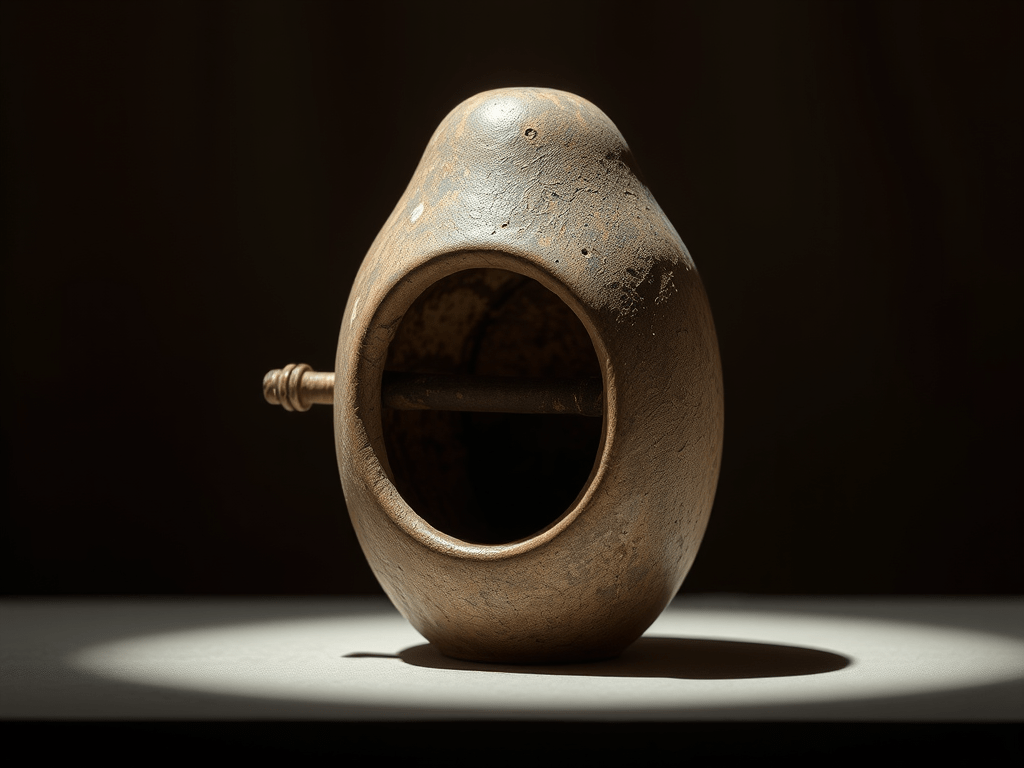
By now, most people have probably heard about the so-called “Baghdad battery,” an object that has been claimed by many people to be an ancient Persian galvanic cell, or electric battery. The so-called “battery” consists of a fourteen-centimeter tall ovoid ceramic pot, a copper tube affixed to the aside of the pot with an asphalt seal, and an iron rod affixed to the inside of the copper tube by the same asphalt seal. There was evidence of acidic residue on the inside.
A hypothesis originally proposed in 1940 by the Austrian archaeologist Wilhelm König holds that this object might be an ancient Persian galvanic cell that might have been used for electroplating. This hypothesis, despite having been repeatedly debunked, keeps being repeated by popular science authors.
König’s battery hypothesis also, unfortunately, keeps getting repeated by people who I can only describe as “New Agers” who keep claiming that the so-called “Baghdad battery” is an “out-of-place artifact” or “OOPArt” and that it is evidence that there was a prehistoric civilization with modern levels of technology that we don’t have record of.
In reality, even if the so-called “Baghdad battery” really were a battery, it certainly would not be evidence for the existence of an unbelievably technologically advanced prehistoric civilization. Furthermore, archaeologists actually have a pretty good idea of what the so-called “Baghdad battery” was used for—and it almost certainly wasn’t used as a battery.
The popular belief concerning the so-called “Baghdad battery”
In around 1938 or thereabouts, the Austrian painter Wilhelm König, who was serving as an assistant to the leader of the Baghdad Antiquity Administration, discovered the object that has now become known as the “Baghdad battery” in the storage room of the Iraq Museum in Baghdad. The object had supposedly been originally unearthed at a site just southeast of Baghdad called Khujut Rabu, but its original find location is not adequately documented.
König was forced to return to Austria in February 1939 due to health problems. In 1940, he published a book in German titled Neue Jahre Irak in which he speculated that the object he had seen in Baghdad might have been a primitive ancient battery. König argued that maybe “batteries” like this one had been used in ancient Mesopotamia for electroplating. He tried to support this hypothesis by noting several ancient Mesopotamian artifacts he had seen that were made of silver coated in a very thin layer of gold.
König argued that these artifacts might have been plated using electroplating. Modern archaeologists, however, now generally agree that the objects seen by König were not, in fact, electroplated at all, but rather fire-gilded using mercury. There are therefore no known examples of objects from ancient Mesopotamia that can be reliably described as showing signs of electroplating.
Despite the fact that one of König’s main pieces of evidence has now been invalidated, his hypothesis has become wildly popular among New Agers who are convinced that the “batteries” are technological remnants from Atlantis or gifts brought by aliens. His hypothesis has also, unfortunately, become popular among popular science writers who are eager to show off examples of advanced ancient technology and it has even wormed its way into textbooks on electricity.
ABOVE: Old photograph from Atlas Obscura of the original “Baghdad battery,” which was stolen during the United States’ invasion of Iraq in 2003 and is now missing. No one knows where it is.
The so-called “Baghdad battery” gets stolen
The supposed mystery of the so-called “Baghdad battery” has been further enhanced by the fact that no one knows where it is now. Unfortunately, during the United States’ invasion of Iraq in April 2003, the Iraq Museum was utterly ransacked. Somewhere between 14,000 and 15,000 ancient artifacts in the museum’s collection—about half of the museum’s total collection—were stolen, including the original so-called “Baghdad battery.”
Eventually, after years of searching, roughly 7,000 artifacts were eventually recovered and returned to the Iraq Museum. The “Baghdad battery,” however, was not one of these objects. The so-called “Baghdad battery” was almost certainly sold on the black market. To date, no one has the faintest clue where it might be.
The theft of the so-called “battery” in 2003 spawned a news article from the BBC lamenting the loss of such a priceless ancient artifact. Other articles of a similar nature have been published since then. The so-called “Bagdad battery” is probably the most famous artifact that was housed in the Iraq Museum that is still missing.
I imagine that the so-called “Baghdad battery” will probably turn up at an auction house a few decades from now and get sold to some American billionaire for several million dollars. This is, after all, exactly what happened to the Archimedes Palimpsest, which was stolen from the Metochion in Istanbul in around 1920 during the Greco-Turkish War. It resurfaced decades later when it was sold at Christie’s Auction House in 1998 to an anonymous wealthy American who is widely believed to be Jeff Bezos, the founder and CEO of Amazon.
ABOVE: Photograph of Amazon CEO Jeff Bezos who is widely thought to be the current owner of the Archimedes Palimpsest. In twenty years, some billionaire like him could be the private owner of the so-called “Baghdad battery.”
Objects from a very advanced, highly literate era
Leaving aside the question of where the so-called “Baghdad battery” is right now, let’s talk about where it comes from. Most people who hear about the Baghdad battery wrongly assume it is an extremely ancient artifact from a time when writing had only just been invented. Many people also tend to assume that it must be evidence for the existence of some kind of highly technologically advanced prehistoric civilization with electric power and modern technologies that we have simply lost all record of.
This is certainly not the case. As I have emphasized before in my writings, there were undoubtedly no ancient civilizations that possessed anywhere near the level of technological sophistication that we have today. If there was an ancient civilization with technology resembling ours, it would have, at the very least, left a massive amount of archaeological evidence behind.
Since there is no archaeological evidence whatsoever for modern levels of technology having ever existed in the ancient past, we can be quite sure that this never happened. This isn’t to say that ancient peoples weren’t advanced in their own right, since, as I shall explain in a moment, ancient civilizations were indeed capable of far more than many people today have tendency to assume. Nonetheless, I am saying that they weren’t nearly as advanced as some New Agers and science popularizers today wish they were.
Furthermore, the so-called “Baghdad battery” doesn’t actually date to an extremely ancient time at all. Wilhelm König believed that the so-called “Baghdad battery” dated to the Parthian Era (lasted 247 BC – 224 AD) on the basis of no good evidence, but it is far more likely that it actually dates to the later Sassanian Era (lasted 224 – 651 AD), since the ceramic pot is in the Sassanian pottery style.
The so-called “Baghdad battery,” then, was most likely originally created sometime between c. 224 and c. 651 AD. This is a time period for which we have extensive written records and during which we know a relatively advanced ancient civilization (i.e. the Sassanian Empire) existed.
ABOVE: Photograph from Wikimedia Commons of the Palace of Ardashir, a ruined Sassanian palace built in 224 AD by King Ardashir I of the Sassanian Empire, dating to roughly the same time period as the so-called “Baghdad battery.” (You can read more about it in this article I wrote in January 2020.)
We know that the Sassanians were highly sophisticated in their own right because they were building monuments such as the Palace of Ardashir and the Arch of Ktesiphon, which actually require a vastly greater level of technological sophistication than comparatively simple monuments like the pyramids of Giza. (As I discuss in this article from January 2020, pyramids actually don’t require a very high level of technological skill to build; you just need simple hand tools, large quarry of stone, a large labor force, a lot of time, and a lot of hard work.)
The kinds of monuments that the Sassanians were building in late antiquity and the Early Middle Ages, on the other hand, require a great deal of architectural knowledge and engineering skill. In order to build a structure like the Palace of Ardashir, you need architects and engineers with extensive knowledge pertaining to building arches, domes, and vaults. The Arch of Ktesiphon, meanwhile, is still considered the largest single-span vault of unreinforced brickwork in existence.
Given the absence of evidence for a prehistoric civilization with modern levels of technology and the clear evidence that the Sassanians possessed a considerable degree of technological sophistication relative to other cultures in the ancient world, if we assume that the so-called “Baghdad battery” really was a battery (which, for reasons I shall explain, it almost certainly wasn’t), it would make far more sense to assume that the Sassanians developed it themselves than it would to assume that it is a surviving remnant of an extremely advanced prehistoric civilization that we have no record of.
I also feel the need to point out that, even if the whole battery hypothesis were true, the “Baghdad battery” would only be an extremely primitive galvanic cell. That means that, if it did for some reason somehow come from an extremely ancient prehistoric civilization, it wouldn’t prove that that civilization had modern levels of technology, but would instead only show that that civilization had the most rudimentary understanding of electricity.
ABOVE: Photograph from Wikimedia Commons taken in 2016 depicting the Arch of Ktesiphon, a ruined Sassanian monument at the site of Ktesiphon in Iraq dating to the same historical era as the so-called “Baghdad battery”
The real purpose of the so-called “Baghdad battery”
Again, though, all of this nonsense about the so-called “Baghdad battery” supposedly being evidence for a prehistoric civilization with modern levels of technology is really irrelevant because the so-called “Baghdad battery” is not really a battery at all. We know this because it bears a very close resemblance to objects with an identifiable purpose found by a team of archaeologists from the University of Michigan in 1930 at the site of Seleukia, not far from Baghdad.
The objects found at Seleukia look almost just like the so-called “Baghdad battery,” but we know they were, in fact, used to hold papyrus scrolls because they all contained remnants of papyrus scrolls when they were excavated. The scroll-holders from Seleukia consist of a metal rod that the scroll could be wrapped around and a tube inside a ceramic pot that the scroll to be slid inside for protection.
Most likely, the so-called “Baghdad battery” is just a scroll container. The scroll was meant to be wrapped around the iron rod, slid inside the copper tube, and then slipped inside the ceramic container, which could then be sealed to protect the scroll inside. The acidic residue on the inside of the container most likely comes from the papyrus or parchment of the scroll that the pot once contained, since papyrus and parchment are both slightly acidic.
Eventually, the scroll decomposed, leaving the acidic residue behind. The container was found by someone at some point and it somehow wound up in the hands of Wilhelm König, who did not recognize the object as a scroll container and speculated that maybe it was an ancient battery. Thus, the whole legend of the so-called “Baghdad battery” was born.
Mythbusters on the so-called “Baghdad battery”
Now, I’m sure some people are already getting ready to cite Mythbusters to me and say, “But Mythbusters tested the Baghdad battery and they found that it worked!” It is true that Mythbusters was able to create electricity using devices modeled on the Baghdad battery, but there are a lot of problems and caveats here that need to be pointed out.
Most notably, the Mythbusters started out with the assumption that the so-called “Baghdad battery” was used as a battery—even though we have no evidence to suggest that it was. They then tried to test how effective that this battery might have been. In other words, they didn’t show that the so-called “Baghdad battery” was actually used as a battery; they only showed that it is possible for people today to make batteries that look like the object from Baghdad.
Furthermore, the Mythbusters had to make a lot of modifications in order to get their “Baghdad batteries” to work. They had to fill their batteries with an electrolyte solution, but we don’t actually have any solid evidence that the actual “Baghdad battery” was filled with such a solution; all we know is that there was some acidic residue, which could have been left by all kinds of things, including decomposed papyrus or parchment.
The Mythbusters also found that one “battery” only produced about one third of a volt of low current. In order to get the batteries to do anything productive at all, they had to wire multiple of them together. There is no evidence, however, that the actual ancient “Baghdad battery” was ever wired to any other such devices. In fact, no wiring of any kind whatsoever seems to have been found in association with the so-called “battery.”
Meanwhile, even with a whole bunch of the batteries all wired together, the Mythbusters were only able to produce a relatively small amount of electricity. A set of ten batteries put together was only able to produce about four volts. This is hardly a high standard of effectiveness.
ABOVE: Screenshot of the Mythbusters manufacturing crude batteries resembling the artifact from Baghdad from their segment on the so-called “Baghdad batteries”
The Mythbusters aren’t “what you call ‘experts’” when it comes to history
It is important to emphasize that the folks on Mythbusters are not historians or archaeologists themselves and they do not appear to regularly consult with historians or archaeologists on the myths they test. For instance, they memorably tested the popular legend about Archimedes of Syracuse (lived c. 287 – c. 212 BC) having allegedly built a death ray using mirrors without even discussing the historical sources for this myth.
As I discuss in this article I published in April 2019, there was actually no need for the Mythbusters to test the myth because we know that the whole story about Archimedes’s alleged death ray arose as a piece of random speculation by the Greek architect and mathematician Anthemios of Tralles (lived c. 474 – 533 x 558 AD) around seven hundred years after Archimedes’s death.
Anthemios had heard a legend (which is itself first attested in the late second century AD, around four hundred years after Archimedes’s death) that Archimedes had used science to set fire to the enemy ships during the Siege of Syracuse. Anthemios speculated that maybe Archimedes could have done this using mirrors. Thus, the whole legend was born.
The Mythbusters didn’t investigate how the legend arose at all, though, and simply tested to see if it was possible to use mirrors to set fire to enemy ships. Likewise, with the so-called “Baghdad batteries,” they didn’t really investigate the possibility that the object from Baghdad might not have been a battery at all; they don’t seem to have really read up on alternative explanations and they certainly didn’t test any.
ABOVE: Fresco from c. 1599 by the Italian painter Giulio Parigi of Archimedes using a mirror to burn the Roman ships. This certainly never really happened.
Conclusion
The shocking truth about the mysterious so-called “Baghdad battery” is that it is just an ordinary vessel used to store sacred scrolls. It isn’t an “out-of-place artifact” and it certainly isn’t a remnant from some lost prehistoric civilization with a level of technology rivalling our own.
Honestly, the real mystery of the so-called “Baghdad battery” isn’t what it was used for, but rather where it is currently. It almost certainly isn’t a battery, but it is still an interesting ancient artifact. Hopefully, it will be found soon and returned to the Iraq Museum where it rightfully belongs. If not, it will probably end up eventually decorating some billionaire’s mansion.
Article taken from: https://talesoftimesforgotten.com/2020/03/08/debunking-the-so-called-baghdad-battery/
Author: Spencer McDaniel (a bio in her own words):
I am a historian mainly interested in ancient Greek cultural and social history. Some of my main historical interests include ancient religion and myth; gender and sexuality; ethnicity; and interactions between Greeks and foreign cultures. I hold a BA in history and classical studies (Ancient Greek and Latin languages and literature), with departmental honors in history, from Indiana University Bloomington (May 2022) and an MA in Ancient Greek and Roman Studies from Brandeis University (May 2024).



 The History Scrutineer
Leave a comment