
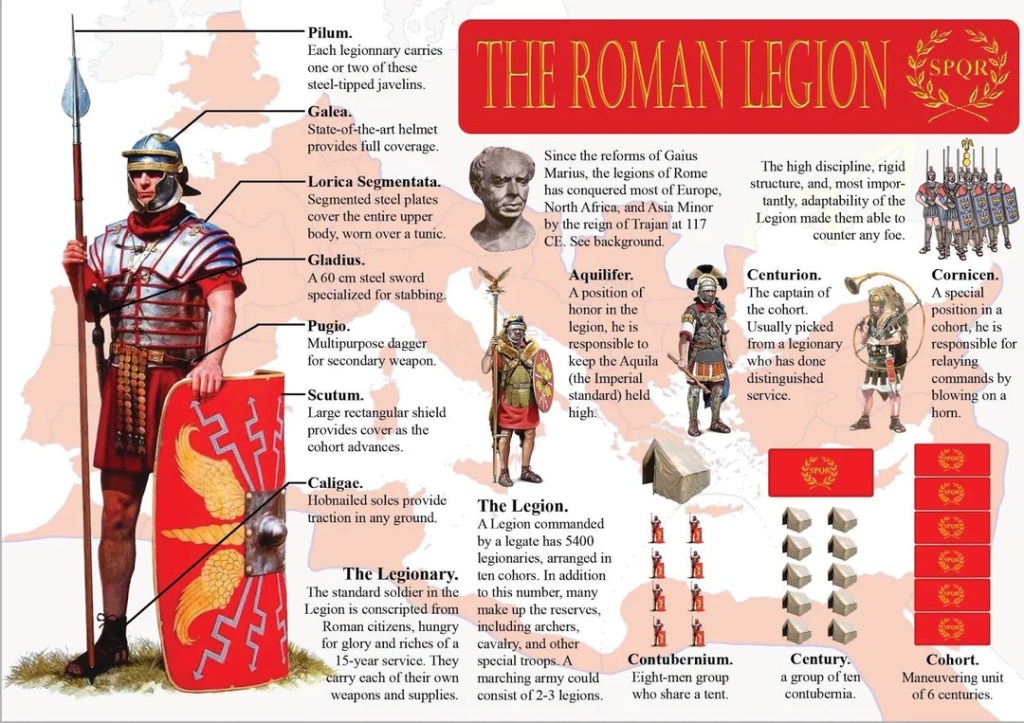
The theory that the IX Hispana (Roman 9th Legion) was destroyed on campaign in the north of Roman Britain was first put forth by Theodore Mommsen in the 19th century but archaeological finds since then have cast doubt on Mommsen’s theory. The last definite evidence of the Legion in Britain dates to 108 AD when it was involved in rebuilding the legionary fortress at York. Finds in 2015 of inscriptions on tiles and dedication stones seems to indicate that at least part of the legion and some of its most senior officers were on the island after 108 AD. After about 120 AD the legion seems to disappear from the pages of history. Sometime between 210 AD and 230 AD, Dio Cassius drew up a list of 33 legions, and Legio IX Hispana was not amongst them, so all one can truly say is that between 120 and Dio Cassius, the legion was destroyed or disbanded. Where and when that took place is anybody’s guess for now – unless new finds show are eventually uncovered.
There seems to be a great deal of speculation about what happened to The Ninth legion as it moved northwards across England, and then into Scotland, to seeminly dissappear completely.
Four legions participated in the Roman invasion of Britain in AD 43: the Second, the Fourteenth, the Ninth and the Twentieth. The Ninth, originally raised by the Emperor Augustus, had been awarded the title Hispana for its bravery during the wars against the tribes in northern Spain. The full Roman name for this Legion was Legio IX Hispana.
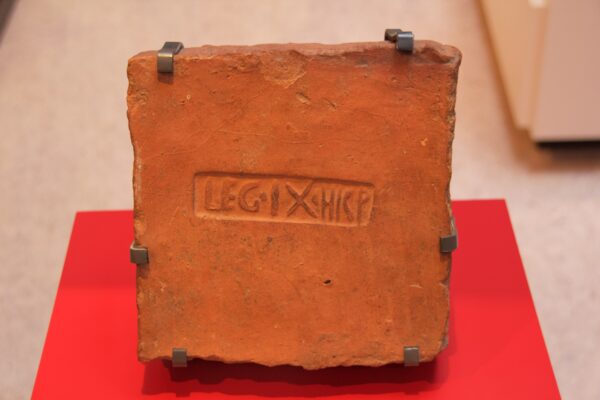
By the early AD 70s the Ninth Legion had moved up from Lincoln to its new bases at York and Malton. Roman bricks and tiles were often stamped with the name of the legion supervising their production and, at York and Malton, complete examples (and fragments) have been discovered marked with the letters LEG IX HISP (Figure 1).
From Yorkshire the Ninth was involved in campaigns across the North and into Scotland. But its military reputation within Britain was far from outstanding, having been badly mauled by Boudicca`s troops in AD 61. Also, in his biography of his father-in-law, Julius Agricola, who was Roman governor in Britain during the Scottish campaigns, the Roman historian Tacitus explained how the Legion had been attacked as it was considered `the weakest point`.
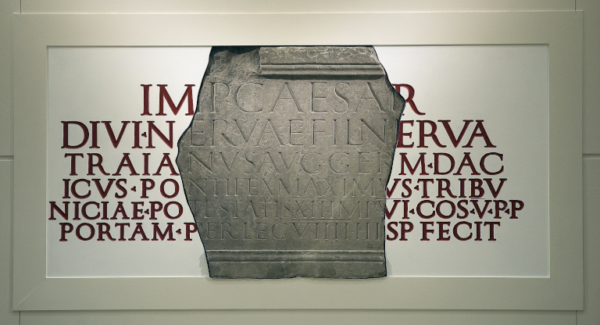
After campaigning in Scotland, the Ninth returned to York as evidenced by an inscription discovered near the south-east gateway of the Roman Fortress (Figure 2) and translated as:
The Emperor Caesar Nerva Trajan Augustus, son of the deified Nerva, Conqueror of Germany, Conqueror of Dacia, pontifex maximus, in his twelfth year of tribunician power, six times acclaimed imperator, five times consul, father of his country, built this gate by the agency of the Ninth Legion Hispana.
This can be dated to AD 108.
However, after this the Ninth seems to have disappeared from the historical record, a mystery that has intrigued numerous individuals since the 18th century. It was replaced in York by the Sixth which travelled to the province with the Emperor Hadrian in AD 122 and no inscriptions referring to the Ninth have been found anywhere on Hadrian`s Wall. Moreover, the list of Roman legions on the Collonetta Maffei pillar in Rome (dated to AD 168) makes no mention of any Ninth Legion.
There are various theories surrounding the demise of the Ninth. Some argue that it left the province for the continent and finished its days fighting along the Rhine or the Danube. Certainly, some brick and tile stamps unearthed around Nijmegen imply that at least a detachment was deployed to the region sometime between AD 104 and AD 120.
Other historians believe the fate of the Ninth can be put down to redeployment in the East, with the Legion being sent to help quell the Second or the Third Jewish revolts in Palestine in AD 115 or AD 132. Others suggest that the Legion was destroyed in Armenia during Marcus Aurelius’ Parthian War. The Roman historian Dio Cassius stated that a Parthian army surrounded and annihilated an entire Roman unit during the conflict, but failed to name it.
The traditional view originally put forward by Theodor Mommsen in the 1850s was that the Legion was simply wiped out in action within northern Britain soon after AD 108, perhaps during a rising of the Brigantes against Roman rule. This view was further popularised in the 1954 novel The Eagle of the Ninth by Rosemary Sutcliffe that paints a picture of the Ninth Legion marching into the mists of Scotland, never to be seen again.
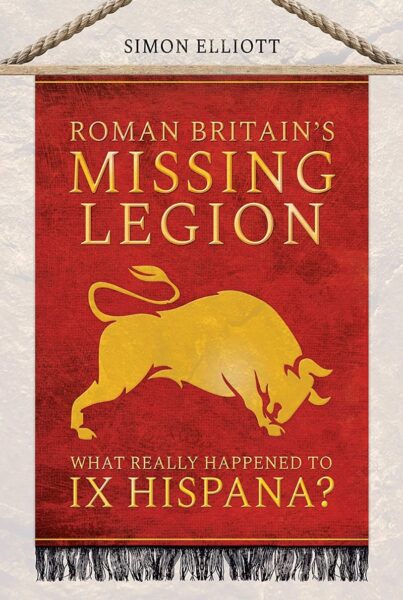
Dr Simon Elliott`s recent book takes up the mantle from Mommsen arguing that the Legion was most likely lost in dramatic circumstances somewhere north of York. But echoing Rosemary Sutcliffe we now just need to find the location of the Ninth`s final stand and, if possible, their Eagle too!
Taken from: https://www.maltonmuseum.co.uk/2021/05/15/the-fate-of-the-ninth-legion/
A dramatised recap of a movie depicting the exploits of the Roman 9th Legion.
 The History Scrutineer
Leave a comment