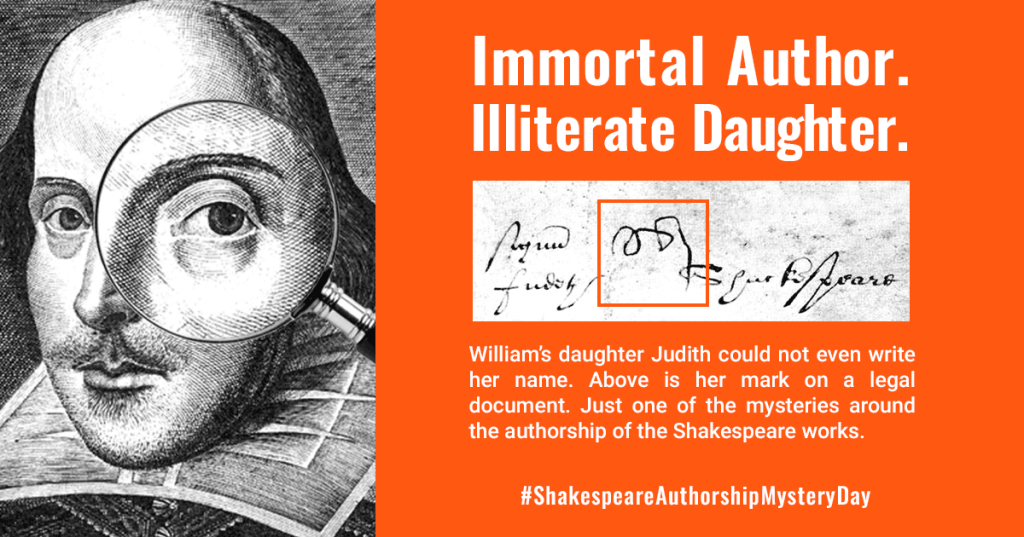
William Shakespeare’s parents were most probably illiterate as well as his own children.
*William Shakespeare (26 April 1564 (baptised) – 23 April 1616) was an English poet, playwright, and actor, widely regarded as the greatest writer in the English language and the World’s pre-eminent dramatist. He is often called England’s national poet and the “Bard of Avon”.
Nobody knows for sure but it’s quite likely that John and Mary Shakespeare (the parents) never learned to read or write, as was often the case for people of their standing during the Elizabethan era. Some have argued that John’s civic duties would have required basic literacy but in any event he always signed his name with a mark. William, on the other hand, is thought to have attended Stratford’s local grammar school, where he would likely have mastered reading and Latin. His wife and their two children who lived to adulthood, Susanna and Judith, are thought to have been illiterate, although Susanna could scrawl her signature.
Taken from: https://www.history.com/articles/10-things-you-didnt-know-about-william-shakespeare
Shakespeare was born, brought up, and buried in Stratford-upon-Avon, where he maintained a household throughout the duration of his career in London. A market town of around 1,500 residents about 100 miles (160 km) north-west of London, Stratford was a centre for the slaughter, marketing, and distribution of sheep, as well as for hide tanning and wool trading. Anti-Stratfordians often portray the town as a cultural backwater lacking the environment necessary to nurture a genius and depict Shakespeare as ignorant and illiterate.
Shakespeare’s father, John Shakespeare, was a glover (glove-maker) and town official. He married Mary Arden, one of the Ardens of Warwickshire, a family of the local gentry. Both signed their names with a mark, and no other examples of their handwriting are extant. This is often used as an indication that Shakespeare was brought up in an illiterate household. There is also no evidence that Shakespeare’s two daughters were literate, save for two signatures by Susanna that appear to be “drawn” instead of written with a practised hand. His other daughter, Judith, signed a legal document with a mark. Anti-Stratfordians consider these marks and the rudimentary signature style evidence of illiteracy and consider Shakespeare’s plays, which “depict women across the social spectrum composing, reading, or delivering letters,” evidence that the author came from a more educated background.
Anti-Stratfordians consider Shakespeare’s background incompatible with that attributable to the author of the Shakespeare canon, which exhibits an intimacy with court politics and culture, foreign countries, and aristocratic sports such as hunting, falconry, tennis, and lawn-bowling. Some find that the works show little sympathy for upwardly mobile types such as John Shakespeare and his son and that the author portrays individual commoners comically, as objects of ridicule. Commoners in groups are said to be depicted typically as dangerous mobs.
Taken from WikiCommons.
The question of how a writer as celebrated and brilliant as Shakespeare could have had illiterate daughters was posed on Quora: https://www.reddit.com/r/shakespeare/comments/rh80xr/how_is_it_possible_shakespeares_daughters_were/
A response to the quiery:
“We don’t know whether they were or not; both are possible. On one hand, education wasn’t seen as necessary for women at the time; on the other hand, we have evidence that girls were enrolled in the public school in Stratford. On another hand, the signature of one of his daughters appears as a scrawl while the signature of the other appears perfectly fine; on another hand a signature or lack of one does not definitely establish literacy of the lack of it in the Early Modern era.
Quora member.
Mostly the question is usually a lead-in to speculation that Shakespeare didn’t write his own works, when in reality the literacy of his family isn’t a relevant point in that kind of argument.”
William Shakespeare’s ‘legitimacy’ is a major field of historical debate and thus deserves further coverage on The History Scrutineer. It is hoped that this article acted as an interesting introduction to the subject and that it might spur additional investigations into whether or not William Shakespeare really was whom history has celebrated him to be…

 The History Scrutineer
Leave a comment