
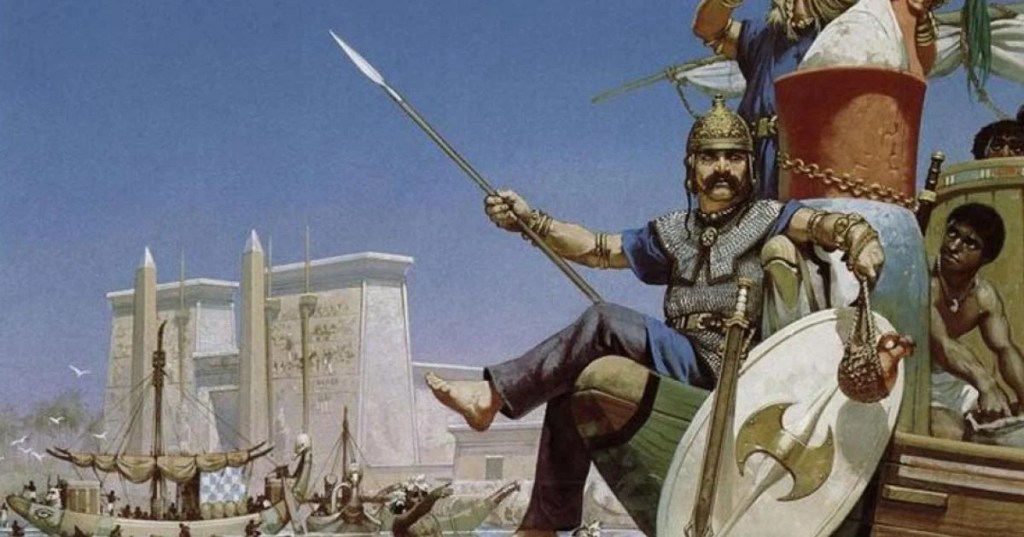
As for the Celts who went to Egypt, we find Celtic involvement in the affairs of Ptolemaic Egypt lasted until almost the beginning of the Christian era. in 217 BC 14,000 Celts constituted the major part of the army of the pharaoh Ptolemy IV at the battle of Raphia against Antiochus II of Syria. It was an Egyptian victory, thanks, so the account shows, to the Celtic cavalry. A Celtic cemetery has been found at Hadra, south-east of Alexandria. Not only tombstones but pottery bearing Celtic names have been found there. Famous Celtic graffiti has been found in the chapel of Horus, in the tomb of Seti I, at the great temple of Karnak. Egyptian coins with Celtic motifs on them were struck.
Forty years later and we still find records of Celts serving in the pharaoh’s armies and we also find that the famous Cleopatra (Cleopatra VII, 69-30 BC)had an elite bodyguard of 300 Celtic warriors. When Octavius Caesar (later Augustus) emerged victorious, he ordered the bodyguard to serve Herod the Great in Judea as a token of Roman gratitude and friendship to the king. When Herod the Great died in 4 BC his Celtic bodyguard attended the funeral obsequies.
Taken from ‘The Celts’ by Peter Berresford Ellis, chapter: ‘early celtic history’.

The following is taken from the website: https://balkancelts.wordpress.com/tag/cleopatra/#:~:text=For%20example%2C%20the%20Egyptian%20queen,funeral%20service%20in%204%20BC.
Despite all this, during this period Celtic warriors were a ‘necessary evil’ for any ruler in the region who had aspirations to power, and they were a vital element in all the major military conflicts from Thrace to Babylon, from the Danube to the Nile – sometimes forming substantial parts of both armies in the battles. This continued right up till the 1st c. AD. For example, the Egyptian queen Cleopatra had Celtic mercenaries who formed her personal bodyguard. After her death 400 of them entered the service of the Jewish king Herod the Great, forming part of Herod’s personal bodyguard, and figuring prominently in his funeral service in 4 BC.
However, for many rulers employing Celtic mercenaries became an absolute nightmare. While they were quick to enter the service of anyone who could afford to pay them, and fearless in battle, ultimately, as many generals and kings were to discover to their cost, the Celts served no masters but themselves…
Ancient Origins.net also featured a piece on Celtic warriors serving in Egypt as bodyguards/mercenaries: https://www.ancient-origins.net/history/exploring-little-known-history-celtic-warriors-egypt-005100
In 250 BC, Ptolemy II hired more Celtic warriors to assist the native Egyptian army in road construction and to put down rebellions. He and his son Ptolemy III Euergetes, who became Pharaoh in 247 BC, also employed Celtic mercenaries. This time they marched through Syria and Judea in a victorious campaign against Seleukos Kallinikos, a ruler of the Hellenistic Seleucid Empire, in the invasion of the Seleucid Empire, ravaging Mesopotamia and western Persia. During the reign of Ptolemy IV Philopater (222-205 BC), Celtic soldiers had become a part of the culture of Ptolemaic Egypt. Until the fall of Ptolemaic dynasty, they remained a very important part of the army. Ptolemy V Epiphanes hired an army of Thracian Celts to put down a revolt of the native Egyptian population in Upper Egypt. It is also known that the last ruler of the dynasty – Cleopatra – used the Celtic mercenaries.
Many Celtic warriors found a new home in Egypt, married local women and stayed in the land of the Pharaohs for the remainder of their lives. According to the Greek historian Polybios, the intermarriage between Celtic warriors, and native Egyptian and Greek girls were very common. The children of Celtic-Egyptian marriages were known by the slang term e pigovoi.

 The History Scrutineer
Leave a comment