
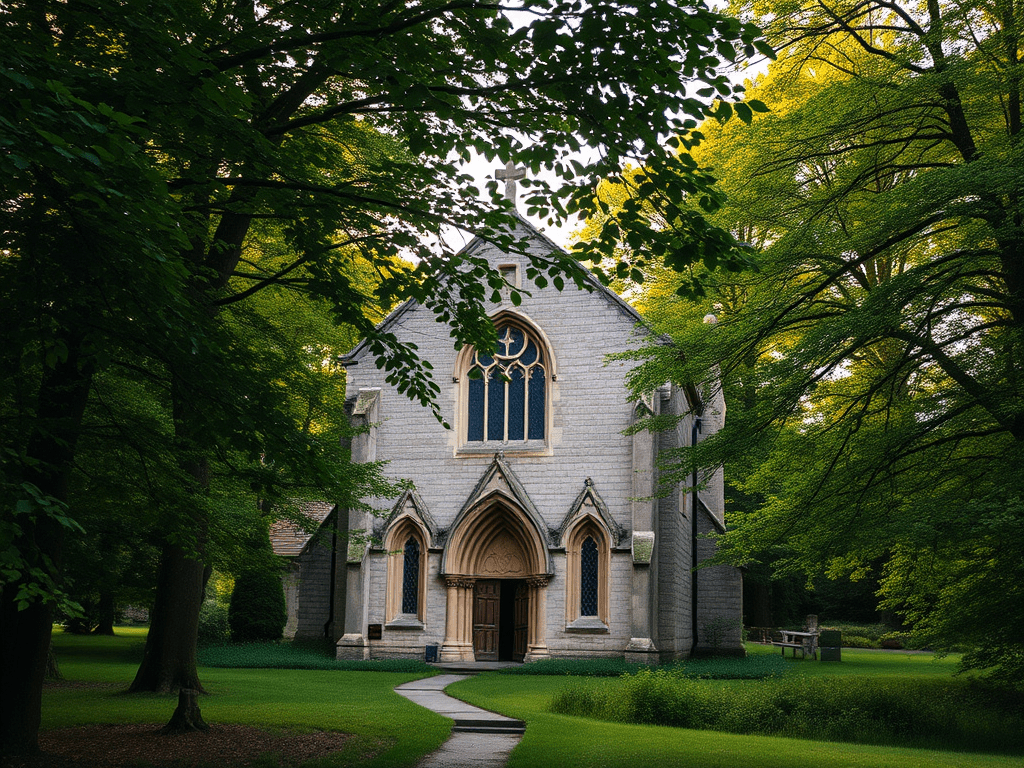
A while ago, I made a spur-of-the-moment Google search for local woodlands in an attempt to find more green spaces for exploring, whereupon I came across a ‘Church Wood’. I am very glad now that I did, for I ended up coming across a most fascinating and unexpected little church, which is so traditionally English and could most certainly be used for the filming of a scene in any period drama.

Church in the Wood, (a.k.a St Leonard’s Church yet originally St Rumbold’s Church) is an Anglican church located within the Hollington area of Hastings borough. Despite having become a large suburb, covered in postwar residential development, the church has survived in the middle of an ancient wood since its initial founding in the 13th century. Restoration work during the Victorian era produced its remarkably early-English Gothic appearance, yet there is also some medieval work, which still remains. Legends and miraculous events have been associated with the church, and its secluded situation interested even writers such as Charles Lamb. The church is a Grade II listed building.

The legends of ‘Church in the Wood’…
It is said that the Devil, himself, was instrumental behind the isolated location and that of many an old Sussex church. The tale goes that every night, all construction work performed during the day would be mysteriously destroyed and the materials disappeared. A menacing voice spoke incessantly to the builders, declaring that the site belonged to the Devil and that it was demanded they build the church elsewhere – far away. If they persisted in trying to build on his land, then great unimaginable suffering would befall them all. Thus, the builders felt compelled to heed the dreadful warnings of the Devil and chose to rebuild the church on a new site which was to the Devil’s liking. The construction was completely successful and took place without any hindrance or complication. A wood grew around the church to conceal it from the parishioners and all those who followed The Lord God. It is thought that the Devil wanted a church for himself and his own demonic worshippers.


Yet then an inexplicable miracle was reportedly performed by a former vicar of the church in the year 1488. The vicar was robbed by three violent criminals when on his way to conduct a service; his tongue and eyes were viciously cut out to stop him recognising or describing the thieves… Soon after, the vicar’s sight and his speech were both restored just in time for him to bring the rogues to justice.
Following taken from Wikipedia:
Nationally known and local writers have frequently remarked on the solitude and visual appeal of Church in the Wood. A description of 1777 noted that although “the graveyard now contains many handsome monuments … it still retains something of the sequestered situation … in the middle of a wood”. A description from 1874 stated simply that “the Church is picturesquely situated in the heart of a romantic wood, having no hut or house of any kind within a quarter of a mile”. Diplock’s Hastings Guidebook of 1845 stated “[i]t is the singularity of [its] situation, more than anything in the building itself, that generally attracts visitors … it looks as if having been forsaken by all human visitants, a thicket had grown up and enclosed it like the Castle of the Sleeping Beauty in the old fairy tale”. London essayist Charles Lamb wrote the best-known description after visiting Hastings in 1823:
“The best thing I hit upon was a small country Church (by whom or when built unknown), standing bare and single in the midst of a grove, with no house or appearance of habitation within a quarter of a mile, only passages diverging from it through beautiful woods, to so many farm houses. There it stands, like the first idea of a Church, before parishioners were thought of, nothing but birds for its congregation…”
Charles Lamb, 1823.


The church is a glorious reminder of English history and our English relationship with the countryside. As mentioned, not only in this article, yet also in https://renegadehistory.com/2024/10/25/englands-first-castle/ – most of the local area for miles and miles is now covered in ugly housing all of kinds known to man. From council estates to care homes. Church wood, is a very small, little area, which must by all means be protected, which it currently is – thankfully. On leaving the site, where I busied myself snapping photographs and a short video (featured further below), I entered the ugly, constantly grim-looking, built-up landscape, where a string of three police cars – sirens blazing, raced down the road past all pedestrians – on their way to who knew what sort of a scene… It is crucial that we hang onto these historic places in nature, so that we may always be reminded of a once far more picturesque, quaint, pleasant country. Plently of other Englishmen, have been appalled by the ruin of the Sussex coastline, I quote, John Carey who wrote the introduction of Graham Greene’s ‘Brighton Rock’, Everyman’s Library version, published by David Cambell publishers of London:
Introduction, John Carey, page vii:
-Not only is it Brighton that the masses have invaded. Their depredations stretch out into the countryside – or what had been the countryside.
– The Queen of Hearts roadhouse, where the gang go after Spicer’s death, is a ‘broken’ farm, its Tudor barn converted into restaurants and bars. In all this, we read the alarm at population growth, ribbon development, and the spread of suburbs, that many writers and intellectuals – H.G. Wells, E. M Forster, D.H Lawrence – had been voicing since the start of the twentieth century.
-To such conservationists, Peacehaven was the paramount scandal and eyesore. Begun in 1922, it comprised a monstrous eruption of bungalows, stuck onto a grid-pattern of new roads on the Downs east of Brighton. The historian of suburbia, Arthur M. Edwards, selects it as ‘the worst example of shackland in Britain’:
“It was on the south coast, and particularly at Peacehaven on the South Downs, that inter-war suburbia reached its nadir. At Peacehaven the South Coast Land and Resort Company Ltd. (a body which describes itself as ‘one of the most enterprising town-planning organisations of modern times’) caused a stretch of open down on top of the channel cliffs to be spattered with development… There can be few English landscapes less suited to such exploitation than the “blunt, bowheaded, whalebacked downs” of Kipling’s Sussex. Peacehaven’s flimsy shacks were set on a naked plateau. There were no trees to mask them from the public eye, and no hedges to give shelter from the channel gales. It must have been as uncomfortable to live in as it was disagreeable to look at. Its developers not only created one of the ugliest townships in England, they destroyed a lovely landscape in the process.” The Design of Suburbia, published in 1981.
Dear reader, if only all of these individuals could see it now. Decidedly and far worse, it has become. The population growth in recent years is producing a further housing crisis, and place Britain’s ancient woodlands in terrible, terrible jeopardy.





 The History Scrutineer
Leave a comment