
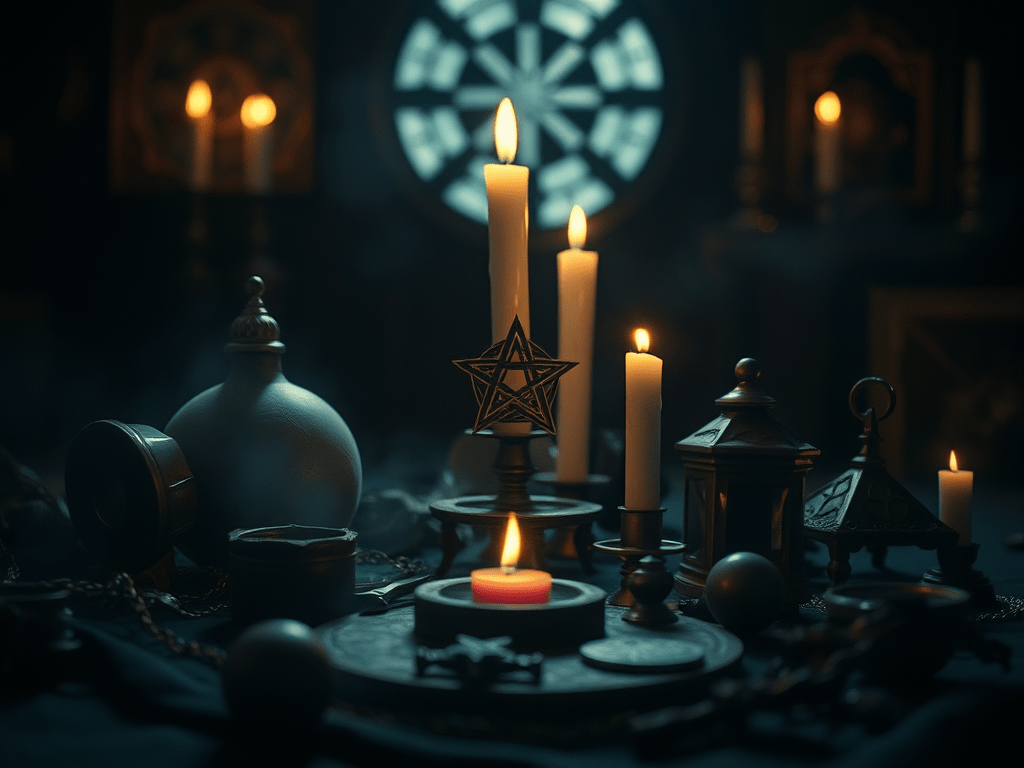
A fascinating subject, ‘esotericism’ is quite simply the name given to secret, guarded knowledge kept and maintained within a selective, small group or inner circle. In fact, the very word – ‘esotericism’ is indeed from the Greek ‘esoterikos’, which roughly translates into the English language as “belonging to an inner circle”. Esotericism has historically carried the following components: Alchemy, Spiritualism, Gnosticism, Mysticism, Meditation, Yoga, Astrology, Hypnosis, Magic and Occultism. As explained, the knowledge gained within the arenas by a secretive few, has been carefully hidden from the masses and utilised (almost needless to say) for the wellbeing, progress and prosperity of those who’ve formed these small groups of ‘esoterics’.
There appears to be one shared and common belief amongst the historical esoterics, and that was the idea that human spirits and souls had been disconnected entirely from their true state of universal power and existence, for humans were divine beings and furthermore had lost all inner knowledge of such and were completely ignorant to any means of escape. The mission, thus, was for esoterics to reacquire the spiritual tools and ‘keys’ so to speak, so that the human might become liberated of the body (or the flesh) and return once and for all to his/her spiritual realm.

Western Esotericism.
A preliminary point to mention, on the subject of ‘western’ esotericism, is the following: the ideas formed within the differing groups, were very much detached from the teachings of both the Judeo-Christian religion and the rationalism which came from the ‘Age Of Enlightenment’ (roughly 1685 – 1815). ‘Esotericism’, as a term, began to be used during the 17th Century in Europe, as a means to label unorthodox belief systems and practices falling under the next three categories.
- Perennial philosophy. An inner, hidden knowledge and power, a central theme to Neoplatonism – in short, the ideology of “The One”.
- Beliefs which provided a decidedly more ‘enchanted’ view of the world during times of much disenchantment.
- All ‘rejected knowledge’, shunned by both the scientific establishment and Orthodox religious authorities.
‘Schools of thought’ were created and entertained by a certain few during the era of Late Antiquity within the Eastern Mediterranean, where philosophical debate was unlimited and the teachings completely diverse and differing from mainstream Christianity. Then, throughout The Renaissance, intellectuals became most intrigued and obsessed with the ideas and beliefs previously discussed by the first western esoterics, whereupon many of them went as far to combine pagan philosophies with both the Kabbalah and Christian theology. Things took a debatable ‘darker’ turn in the 17th Century, again, when (for lack of a better term) ‘secret societies’ or ‘secretive’ – better said, such as the notable Rosicrucians and Freemasons (some would jump at the chance to include the Illuminati here as well), professed deep esoteric knowledge. These were, of course, bold examples of hidden knowledge being guarded and made inaccessible to the ‘common’ man, woman and child outside of these ‘societies’; all equipped with their own peculiar initiations, traditions, activities and ceremonies.

The 18th Century saw an even ‘deeper dive’ being taken during the climax of the Age Of Enlightenment whereas the 19th Century saw Europe’s esoterics take a swift swerve down the road of occultism, more than anything else. The Hermetic Order Of The Golden Dawn, being perhaps the greatest profoundly outlandish name of a prominent group of the time, devoting itself to ‘spiritual science’. As Occultism became more and more explored, paganism reappeared and gave way to bizarre movements such as that of the ‘Wicca’. Also known as “The Craft”, ‘Wicca’ is a supposed earth-centred religion where all sorts of carry-on takes place, from what I, myself, gather, tunic-clad priestesses clutching fancy daggers dance in circles wearing pentacles as they worship the ‘Horned God’ and ‘Mother Goddess’.


A counterculture came about during the 1960s as cultism and even satanism overshadowed the esoteric movements, taking the historical search and guarding of deep, universal knowledge down a perverse path before the New Age phenomenon erupted in the 1970s – holistic, mind-body-spirit practices gaining scores of followers in the Western World.
It was around this point, where European scholars such as notably, Antione Faivre and Frances Yates, only began and instigated a formal study of esotericism in the late 20th Century.
Eastern Esotericism.
The esotericism encountered across ‘eastern’ cultures, is far more complex and less easily placed onto a clear chronological timeline as was the case with western esotericism. The demarcation of eastern esotericism as an academic field is rather tricky, for its entirely depends upon the boundaries of geographical and cultural notions concerning what ‘eastern’ really is. However, scholars who explore the study, do so mostly concerning themselves with beliefs encountered within Buddhist, Hindu and certain Islamic groups. It is the custom perhaps, amongst these scholars and experts, to attribute eastern esotericism to doctrines found within Hinduism – the tantras and yoga, branches of buddhism encountered throughout Asia from Tibet to Japan, and other ‘non-sectarian’ practices such as those of the ‘Baul’ from places like Bangladesh.
Joao Rodrigues, a Portuguese sailor, soldier and Jesuit (roughly 1561 – 1634) made several points on the Chinese doctrines of Buddhism, Confucianism and Taoism.
“The three sects of the Chinese follow entirely this way of philosophising. They have two kinds of doctrine. The one they consider true is secret, and only the literates understand it and teach it by employing symbols. The other, vulgar… is considered by the literati to be false in the ordinary sense. They make use of it for divine as well as for civil and fabulous worship, thus leading the people to good and keeping them from evil”.
“The other method is speculative and deals philosophically with what God is, how this world was made, and everything else related to it. All this doctrine is hidden in various, very obscure symbols that only a few people understand, and profess to be the greatest secret.”
“Until I entered China, our fathers – of China, knew practically nothing about this (distinction between external and internal teachings) and about the speculative (internal) doctrine. They knew only about the civil and popular (external) doctrine because there was no one to explain and enlighten them”.
Those three intriguing points stated by the bold Joao Rodrigues, provide some key declarations, which perfectly demonstrate the secretive nature of esotericism – whether it were of the eastern or western persuasion.
To touch upon Hinduism, numerology (to also touch upon the use of symbols in esotericism), was of much great importance – especially on the subject of ‘tantras’.

There is a five-element classification presented within the tantras. For instance, the set of “five Ms” (they do not all begin with the letter ‘m’ in English) – fish, meat, wine, mudrā, and sexual intercourse. Then there are the five bodily fluids: faeces, urine, blood, semen and sweat. Further along, there are the five skandhas – factors of existence, the four kayas (Buddha bodies) and the triad prajña, upāya, bodhicitta – “wisdom”, “means”, “enlightened mind”. These words are also identified with the triad’s female-masculine-union. Amitābha/Akṣobhya/Vairocana are three elements assigned to the groups of water, fire and space.
Sanskrit, is considered a “sacred language” for its language and vocalisation acquired mystical connotations. The sounds and characters, from consonants and vowels to syllables and words appeared to carry an occult and secretive background. A most famous example is found in the uttering of the sound ‘Om’. Brahmin priests cited cryptic riddles during the initiation of rituals containing what they believed to be esoteric secrets. Such riddles were also popular in private eastern circles.


Conclusion.
“The truth has never denied the seeker, it is the seeker who has denied the truth”.
This increasingly popular saying of almost indeterminable origins, strikes up an image of a human being in a quest to find the truth – of course. We, as humans, have always felt a deep, internal need – a thirst which cannot be quite quenched, to reach full understanding of our existence within the Universe. Ideas and beliefs have varied across the world yet if an individual were to conduct an immense study into for instance – esotericism, he or she would find (after much research and study for this is an extremely broad field) that these certain core elements of these differing ideas and beliefs are not too far apart.
Have certain groups or better asked, do certain groups (still, to this day) know something that the masses don’t? Was, and is there true, secret knowledge, hidden away from the majority and benefited from solely by those select, secretive few?
This is a trapdoor with several slides below. Several tunnels, several routes…
Here at The History Scrutineer, we welcome a wider discussion from whatever or whichever angel, on the puzzling question of esotericism.
 The History Scrutineer
Leave a comment