
This most intriguing ‘conspiracy’ theory is found in what today’s political climate would label as (depending on which side the voice came from) ‘white-supremacy’ and ‘black-supremacy’ circles. The theory is practically the same on both sides yet of course with an obvious distinction depending upon the skin tone/ethnicity of either group.
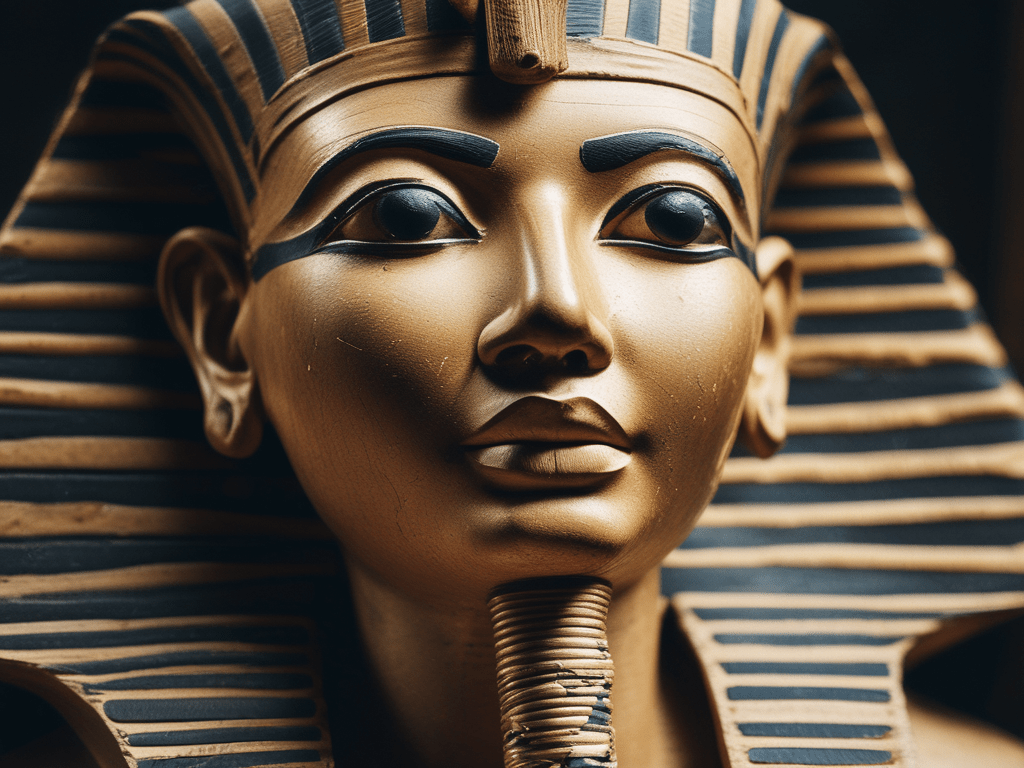
It is believed that the noses were systematically and purposefully vandalised in order to hide the true ethnicity/’racial’ roots of the Egyptians. ‘Afro-centrists’ firmly believe that the Egyptians and their pharaohs were in large part an entirely ‘black African’ race. They claim that European archeologists (notably the British) sought to destroy all possible racial hints – for they, themselves, wished to portray Ancient Egyptian society as having been ‘white’ – as was Greco-Roman civilisation.
However, there does exist some rather curious ‘proof’ of caucasian-featured individuals having existed in Ancient Egypt and also, of such individuals still existing to this day in North Africa.


Other individuals like to try and either rationalise or radicalise the ‘proof’ away. Responses such as the following are all over the internet:
“It’s a well-known belief that hair changes colour to red after death. There has never been any study done to prove that the ancient Egyptian mummies had naturally red hair when they were alive. Rather, their hair became naturally red after they died.” Taken from Quora.
“The Egyptian Arab historian al-Maqrīzī wrote in the 15th century that the nose was actually destroyed by a Sufi Muslim named Muhammad Sa’im al-Dahr. In 1378 CE, Egyptian peasants made offerings to the Great Sphinx in the hope of controlling the flood cycle, which would result in a successful harvest. Outraged by this blatant show of devotion, Sa’im al-Dahr destroyed the nose and was later executed for vandalism.” Taken from a personal blog.
“They were Nubian. Beautiful dark skin and broad features. They would (‘white’ academia) rather attribute African civilizations to aliens than the people. They knocked off their noses because their pronounced features told you very well who they were: Black. “Egyptology” only exists for white people to whitesplain a history that is not their own.” Taken from a personal blog.
“The ancient people of Kemet were black aeons before caucasians ever existed.” Taken from a Youtube comment. Not to be taken particularly seriously, either!
Less radical possibilities.
- Such statues were often re-utilized during the era of antiquity. Temples had become quite obsolete at the time of the later Roman period and then onwards, as people simply changed religions. When people needed materials for construction they would head off and take them from the closest free source. There is evidence of this having carried on right until the 20th century.
- Natural erosion. Most of those statues were constructed from either sandstone or limestone. Being soft stones they are liable to erode very easily when exposed to sand and the elements. Hard stones (ex: granite and basalt) would have fared much better.
In ending this article, The History Scrutineer realises and understands that this is a ‘touchy’ subject amongst historians and it is of our opinion that personal emotions are something of a hindrance to encountering a subjective truth. An individual’s ethnicity/skin colour might mislead he or she into radicalising their belief as to the ethnicity/skin colour of the Ancient Egyptians. A perfectly reasonable and fair conclusion would be one such as the following – sourced from a YouTube commentary:
“The continent of Africa is very large with many different ethnic groups, which come in all complexions.”
Yet the conversation continues…
 The History Scrutineer
Leave a comment